“THE BREXIT VOTING”

Is another referendum required to ensure the preservation of democracy?

The Brexit issue is tearing down democracy in the Western region and is challenging the very fabric of democratic principles and freedoms. Is another referendum required to ensure the preservation of democracy?

To understand this, we have to go back over not only the events of the last three years, but also the reasons and why the UK originally entered European Union through the Maastricht Treaty. The UK never fully committed to the European Union. The UK joined the EU as a way to avoid its economic decline. The UK`s per capita GDP relative to the European Unions’ founding members declines steadily from 1945 to 1972. However, it was relatively stable between 1973 and 2010.

Maastricht – UK never fully committed to the European Union – Monetary Union never happened – fall of the Soviet Union 1989 – influx of migrants from East and GFC contributes and results for people to vote for leaving the European Union. These were the main reasons the referendum took place in 2016. But is today the same situations as it was back then.

Brexit was a referendum in which nearly everyone of voting age took part in and was held on Thursday 23rd June 2016 to decide whether the UK should leave or remain in the European Union. Leave won by 51.9% to 48.1% and more than 30 million people voted. The UK were given a 3-year period in which they would decide whether to leave or stay with the EU but now the deadline has finished. On the 10th of April the UK and EU agreed a second delay to Brexit until the 31st of October.

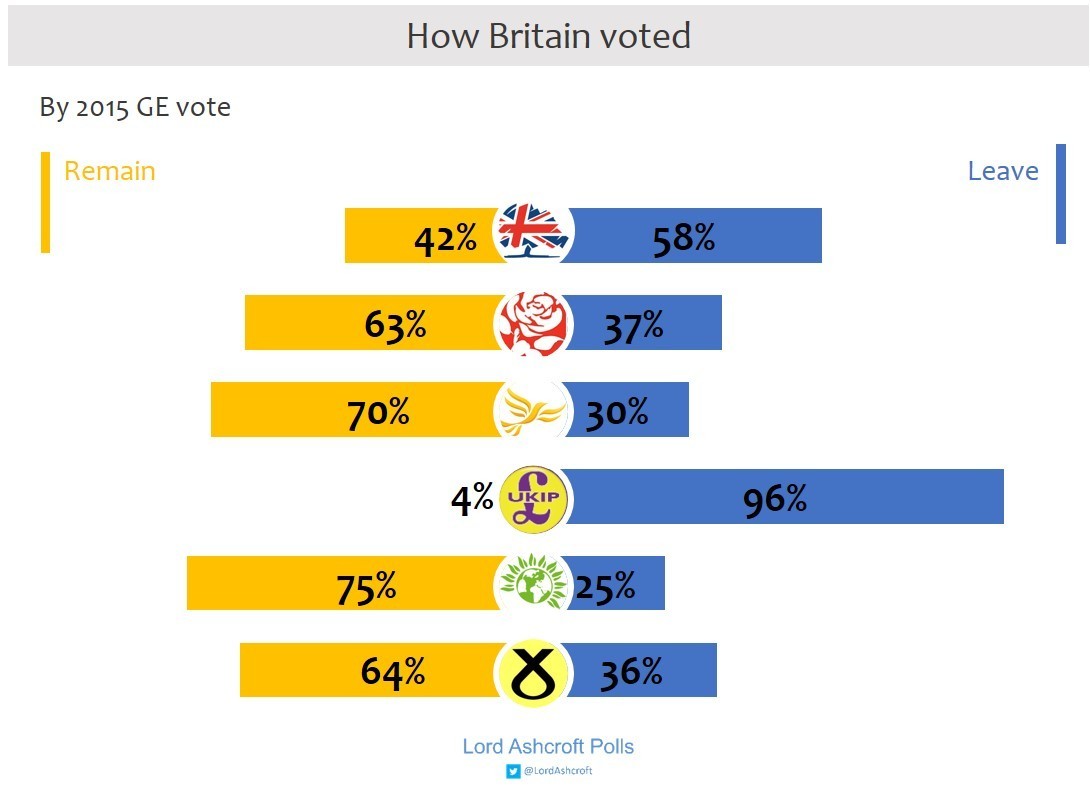
The Mix of results across the UK and EU is very diverse and so this brings a lot of pathways and views of how they should or shouldn`t leave the EU. When you add the Lib Dems’ results to those for the other firmly remain parties – the Greens (12%), the new Change UK Party (3.4%) and the pro-Remain Scottish National Party (3.6%) – and nearly 40% of the vote was in favour of staying in the EU. That’s more than the 35% combined vote of Nigel Farage’s Brexit Party (32%) and his former UKIP grouping, both of which pushed for a no-deal exit. This shows that there is no centre in British politics when it comes to Brexit. Instead of the old left-right differences that allowed the two big parties to dominate, voters increasingly identify with groups that share their view on whether and how Britain should leave the EU. The votes and views to remain or leave is divided by South and North across the UK and EU and this separates and divides the Country apart.


England voted for Brexit, by 53.4% to 46.6%. Wales also voted for Brexit, with Leave getting 52.5% of the vote and Remain 47.5%. Scotland and Northern Ireland both backed staying in the EU. Scotland backed Remain by 62% to 38%, while 55.8% in Northern Ireland voted Remain and 44.2% Leave. There is a wide range of division across the UK and EU due to Brexit.

USA-MEXICO BORDER WALL!!

The Mexican-United States barrier also known as the border wall is a series of vertical barrier along the mexico-united states border intended to reduce illegal immigration to the United States from Mexico. The barriers were built from 1994, by Bill Clinton, as part of three larger operations to taper transportation of illegal drugs manufactured in Latin America and illegal immigration:

“The USA-Mexico Border Wall”

Throughout his 2016 presidential campaign, Donald Trump called for the construction of a much larger and fortified border wall, claiming that if elected, he would build the wall and make Mexico pay for it. More than $1.5 billion of border wall funding has produced 1.7 miles of fencing along the nation’s southern border. The border wall is not really proving effective as their are large gaps not blocked where illegal migrants could get through.

In my opinion Donald Trump is stupid, he has wasted so much money and still there are illegal migrants getting through the border wall. The wall has recently increased the amount of illegal migrants getting through to the USA.

10 REASON SOCCER IS BETTER THAN AFL/FOOTY

1) Popularity

Soccer is the most popular sport in the world in terms of player numbers. According to the 2006 FIFA Big Count, there were 265 million soccer players in the world, 270 million when referees and match officials were included.

2) Support

With so many registered soccer players across the globe, it’s not surprising that soccer has more fans worldwide than any other sport. If you want to become a globally recognized sport star, soccer is a better option than football.

3) Inexpensive

Soccer players don’t need to spend large amounts of money on equipment. The two most costly items are soccer cleats and a ball, and neither need be overly expensive. A jersey, shorts and shin guards are the only other requirements. Football players must buy a large number of protective items for competitive play.

4) Fluid Play

Football is a stop-start game with frequent pauses between each play. Soccer is a more fluid sport, an aspect that appeals to many fans and players.

5) Easy to Learn

It doesn’t take long to learn the basics of soccer. The rules are straightforward and easily defined, with only a few regulations — such as the offside rule, leaving much room for confusion. Football is a more complex sport in terms of set plays and regulations.

6) Physical Requirements

Soccer players don’t need the physical strength of football players. Athleticism and fitness are important, but you don’t need to be physically imposing to play soccer. Some of the world’s top players, such as Lionel Messi, rely purely on skill and creativity rather than strength and stature. This makes soccer a more inclusive sport than football, for men and women.

7) Olympic Sport

If you dream of being an Olympic athlete, football is not the sport for you. Though football was featured in the 1932 Summer Olympics as a demonstration event, the International Olympic Committee has yet to accept football as an Olympic sport. Soccer has been a regular feature of the Olympics since 1900.

8) Global Reach

Soccer has a truly global reach; football is largely contained within North America. Soccer is like an international language that crosses cultural barriers, allowing you to share your love for the game with other fans throughout the world. Whether you are in Brazil, Burundi, Belgium or Bangkok, you find people with a common interest in soccer.

9) International Competition

Soccer provides more opportunities to compete internationally, at amateur and professional levels. Youth teams often go on tour abroad, and individual players can train in soccer camps across the world. At the highest level, soccer also gives you the chance to represent your national team against all other nations on the planet, something that football does not offer in any comparable way.

10) Injuries

Soccer players are less prone to injuries than football players, according to the 2006 High School Sports-Related Injury Surveillance Study sponsored by the Centers for Disease Control and Prevention. The one-year study found that football players had the highest injury rate, with 4.36 injuries per 1,000 athlete exposures. Male and female soccer players had a rate of 2.43 and 2.36, respectively.